Nivqerra
Vertex Map
Vertex Map
Couldn't load pickup availability
1. Problem Statement
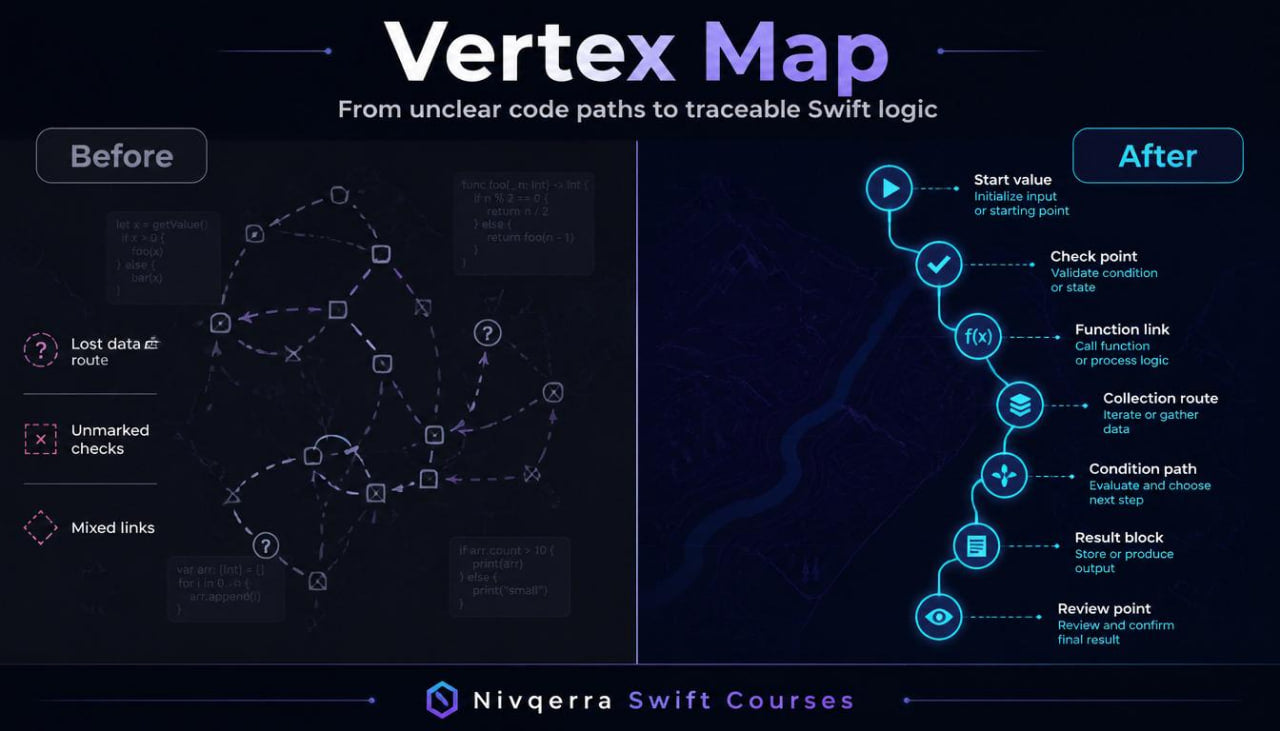
At this stage of study, the learner can already write separate functions, work with collections, and build conditional logic, but larger examples may still be difficult to navigate. The main challenge is often not syntax, but understanding how data moves between code parts. When there are many functions and each one performs a separate action, the learner may lose the connection between starting values, middle handling, and the summary. Collections, loops, and conditions may work together, but without a logic map, such a fragment is hard to explain in personal words. Vertex Map was created so the learner can view the structure of a larger task as a route with points, transitions, and readable connections.
2. Solution
Vertex Map offers a learning approach where every larger Swift code fragment is first studied as a map. The learner sees where the data comes from, which functions receive it, which checks it passes, and where the summary value is formed. The materials explain how to mark key points of a task: start, check, handling, repetition, storage, and result output. Lessons combine text explanations, schemes, code examples, and exercises for independently dividing fragments into parts. This format helps learners not only write more code, but also navigate the logic behind learning examples.
3. What’s Inside
Vertex Map includes a learning route built around logic maps and data routes. If the previous plan helped with planning a task before writing code, this plan shows how to read, mark, and explain larger fragments after they are created or during review.
The first module focuses on the task map. The learner studies a fragment as a set of points: input values, helper variables, checks, loops, functions, and the summary block. The materials explain how to highlight the main parts of a task and separate them from secondary lines. Each example begins with a short description and ends with a map that shows how the logic moves.
The second module covers the data route. The learner follows how a value appears at the start of a fragment, how it changes, where it is passed, and how it affects the summary. In this module, the goal is not only to see the result but to understand the path: a variable is created, a value is checked, a function is called, a list is updated, and the summary is formed. Through this review, the learner can better notice where the key action happens inside the task.
The third module focuses on connections between functions. The learner reviews examples where one function prepares data, another checks it, a third handles it, and a fourth creates a text or numeric result. The materials show how not to get lost among several calls and how to read code by execution order, not only by line placement. A separate section explains how parameters pass information between task parts.
The fourth module focuses on collections as value routes. The learner works with lists, groups of text elements, numeric sets, and simple learning records. Tasks show how data passes through iteration, checking, selection, counting, and creation of a new list. In this module, a collection is viewed as a path where each element may pass through the same or different handling depending on a condition.
The fifth module reviews conditions in a logic map. The learner practices marking places where code changes direction: one condition leads to one block, another leads to another block. The materials explain how to read several conditions without confusion, how to see the main check, and how not to mix middle checks with the core task logic.
The sixth module contains practical maps of learning scenarios. The learner works with examples that include several stages: preparing a list, checking values, handling through functions, and creating a summary text or number. Each scenario is shown in three forms: written description, logic map, and code fragment. After that, the learner receives a similar task where they create a map and explain the data route independently.
The seventh module focuses on reviewing broken routes. Here, the learner studies fragments where logic is mixed, names are unclear, or data is passed in an unexpected place. The task is not about finding difficult errors, but about careful reading: where the route stops, where a value changes too early, where a function does extra work, and where a condition is placed in an inconvenient spot. After the review, the learner edits the fragment and creates a new map.
The plan also includes logic map templates, tables for tracking variables, exercises for explaining code in personal words, a short glossary of ideas, and a task set for review. The materials help learners move from the question “what does this line do?” to “how does the whole task move?”.
4. Who is this for?
Vertex Map is suitable for learners who have already studied basic and middle-stage Swift topics and want to understand larger learning fragments more clearly. This plan is for those who can create functions, work with collections, and write conditions, but want to see the connection between all parts of a task more clearly.
The plan is useful for learners who sometimes lose track of where exactly a value changes or where the summary is formed while reading code. Vertex Map helps view code as a route: first data enters the task, then it passes checks and handling, and at the end the result appears.
This plan fits well after Halo Blueprint, because it continues the work with schemes while focusing not only on planning, but also on navigation inside a prepared fragment. The learner studies how to create structure, explain it, check it, and refine it during review.
5. What You’ll Learn
- How to read a larger Swift fragment as a logic map.
- How to identify starting values, middle actions, and the summary block.
- How to follow the data route between variables, functions, and collections.
- How to see links between several functions in one task.
- How to read execution order, not only line placement.
- How to explain the role of parameters and returned values.
- How to work with collections as a route of elements.
- How to mark conditions that change the direction of logic.
- How to review learning scenarios through description, scheme, and code.
- How to find places where structure becomes confusing.
- How to edit a fragment after analyzing the data route.
- How to use tables for tracking variables.
- How to explain code behavior in personal words without chaotic retelling of lines.
6. 30-day return terms
For paid Nivqerra plans, 30-day return terms apply according to the store rules and refund policy page. Vertex Map belongs to these plans, so before placing an order, the learner can review the request process, review period, and terms related to this plan.
On the plan page, this section should be presented neutrally and without pressure. It can state that payment return requests are reviewed within 30 days after purchase according to the store policy. The detailed process should be placed on a separate page, so the buyer can review the rules before placing an order.
Self-paced learning overview
- 📁 Digital file available after purchase
- ♾️ Long-term availability
- 🔒 Secure checkout
- 🗓️ Content updated in 2026
Do I need previous Swift experience?
Do I need previous Swift experience?
No, some courses are suitable for the starting stage, while others are made for learners who already know basic ideas. Each plan presents the level gradually, so the learner can choose materials that match their current stage.
What format do the materials use?
What format do the materials use?
The courses include modules, lessons, explanations, examples, practical tasks, and learning resources. The materials are structured so learners can return to topics and review selected parts during study.
Can I study at my own pace?
Can I study at my own pace?
Yes, the materials can be completed without a strict schedule. You can spend time on topics, examples, and tasks according to your own routine.
Share