Nivqerra
Origin Capsule
Origin Capsule
Couldn't load pickup availability
1. Problem Statement
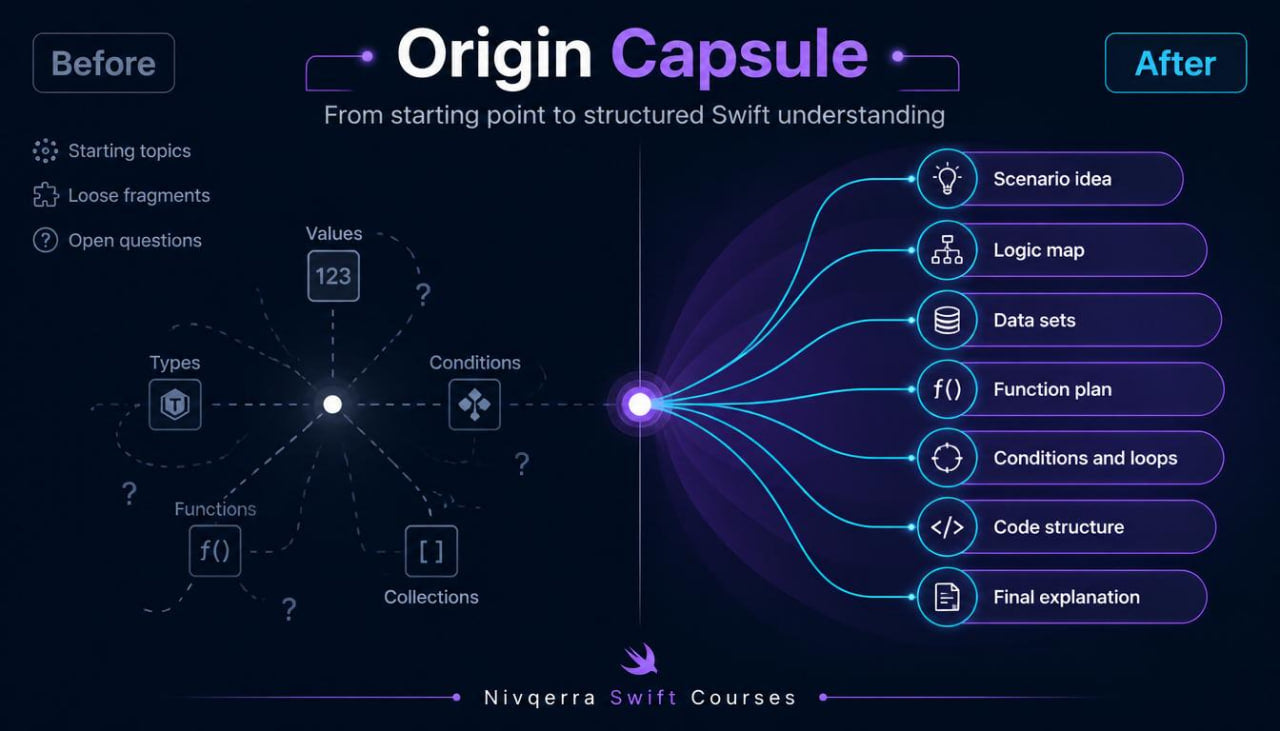
At the final stage of study, the main challenge is bringing all previous topics into one readable system. The learner can already work with variables, functions, conditions, loops, collections, logic maps, and several connected capsules, but a wider task requires careful organization. If the scenario borders, function roles, data route, and order of checks are not defined, code may become too branched. It can also be difficult to explain the prepared fragment in personal words when it was created without an early scheme. Origin Capsule was created so the learner can bring previous skills into one closing learning route with a clear structure.
2. Solution
Origin Capsule presents Swift through a final learning scenario that combines the key topics from previous plans. The learner begins with a task description, then creates a map of parts, defines data, plans functions, adds conditions, works with collections, and gradually builds a full code fragment. The materials show how to review the structure after writing: whether names are readable, whether logic is repeated, whether each function has its own role, and whether the data route can be explained without confusion. Lessons combine planning, writing, reading, editing, and final review. This approach helps close the Nivqerra learning line not with a single exercise, but with a large structured scenario.
3. What’s Inside
Origin Capsule includes a final learning route that brings previous plan topics into one large learning capsule. In this plan, the learner works not only with separate fragments, but with a full scheme: idea, data, functions, collections, conditions, routes, structure review, and result explanation.
The first module focuses on the idea of the final scenario. The learner describes which learning task should be built, which data it uses, which actions it should perform, and which result it should form. The materials help avoid making the scenario too wide and support clear borders: one main task, several helper parts, a readable data route, and a summary block.
The second module covers the architecture of a learning task. The learner creates a map that marks starting data, middle variables, functions, collections, conditions, loops, and the final result. This map becomes the base for writing code. It helps show which parts should stay separate, which can work together, and which only make the structure heavier.
The third module focuses on data and collections. The learner works with value sets that may pass through several stages: creation, checking, selection, grouping, counting, and preparation for the result. The materials show how not to mix starting data with middle and summary values. A separate part reviews creating new sets from previous values.
The fourth module is dedicated to functions in a large capsule. The learner plans functions for separate actions: data preparation, checking, collection handling, counting, text formatting, and result assembly. Lessons show how to name functions by their role, how to pass parameters, how to use returned values, and how to avoid functions that take on too many different actions.
The fifth module develops conditions, loops, and execution routes. The learner studies how different checks guide code through different paths. Some values may pass one handling stage, others another; one condition may skip an element, while another may move it into a new set. The materials help place conditions so they do not break the general scenario logic.
The sixth module contains building the final learning capsule. The learner gradually creates a large fragment: first describing the task, then preparing a map, then creating data, then adding functions, conditions, loops, and a summary block. Each stage includes an explanation so the learner can see why each part stands in its place.
The seventh module focuses on editing and final review. The learner checks the prepared scenario through review questions: whether the main idea is clear, whether function roles are mixed, whether conditions are placed properly, whether the data route can be followed, and whether there is unnecessary repetition. After that, the code is edited, the map is updated, and the learner prepares an explanation of how the scenario works in personal words.
The plan also includes planning sheets, logic maps, tables for tracking data, checklists for structure review, a glossary of more advanced ideas, review exercises, and a final learning scenario template. All materials help the learner complete the Nivqerra learning line through full practical building, not only theory review.
4. Who is this for?
Origin Capsule is suitable for learners who already have experience with previous Nivqerra plans or have a similar Swift study level. This plan is for those who understand basic and middle-stage topics, can read larger code fragments, and want to bring knowledge into one final learning scenario.
It is useful for learners who want to plan a wider task from beginning to end: describe the idea, define data, create functions, build logic, review structure, and explain the result. Origin Capsule also fits a full review of the learning line because it brings topics from previous plans into one shared scenario.
This plan closes the path after Nexus Capsule, where the learner connected several capsules. Here, those links move into a wider final build with a full map, editing, and final review.
5. What You’ll Learn
- How to bring previous Swift topics into one final learning scenario.
- How to describe a task idea before planning code.
- How to set borders for a large learning capsule.
- How to create a logic map for a full scenario.
- How to work with data that passes through several handling stages.
- How to use collections for storing, selecting, and counting values.
- How to create functions with separate roles.
- How to pass data between functions without losing the logic.
- How to place conditions and loops inside a wider structure.
- How to review the data route from start to summary.
- How to edit prepared code after the first writing pass.
- How to remove repeated logic and refine names.
- How to explain a large learning fragment in personal words.
- How to close the Nivqerra learning line through a full practical build.
6. 30-day return terms
For paid Nivqerra plans, 30-day return terms apply according to the store rules and return policy page. Origin Capsule belongs to these plans, so before placing an order, the learner can review the request process, review period, and terms related to this plan.
On the plan page, this section should be presented calmly, transparently, and without pressure. It can state that payment return requests are reviewed within 30 days after purchase according to the store policy. The detailed process is better placed on a separate page, so the buyer can review the rules before placing an order.
Self-paced learning overview
- 📁 Digital file available after purchase
- ♾️ Long-term availability
- 🔒 Secure checkout
- 🗓️ Content updated in 2026
Do I need previous Swift experience?
Do I need previous Swift experience?
No, some courses are suitable for the starting stage, while others are made for learners who already know basic ideas. Each plan presents the level gradually, so the learner can choose materials that match their current stage.
What format do the materials use?
What format do the materials use?
The courses include modules, lessons, explanations, examples, practical tasks, and learning resources. The materials are structured so learners can return to topics and review selected parts during study.
Can I study at my own pace?
Can I study at my own pace?
Yes, the materials can be completed without a strict schedule. You can spend time on topics, examples, and tasks according to your own routine.
Share