Nivqerra
Nexus Capsule
Nexus Capsule
Couldn't load pickup availability
1. Problem Statement
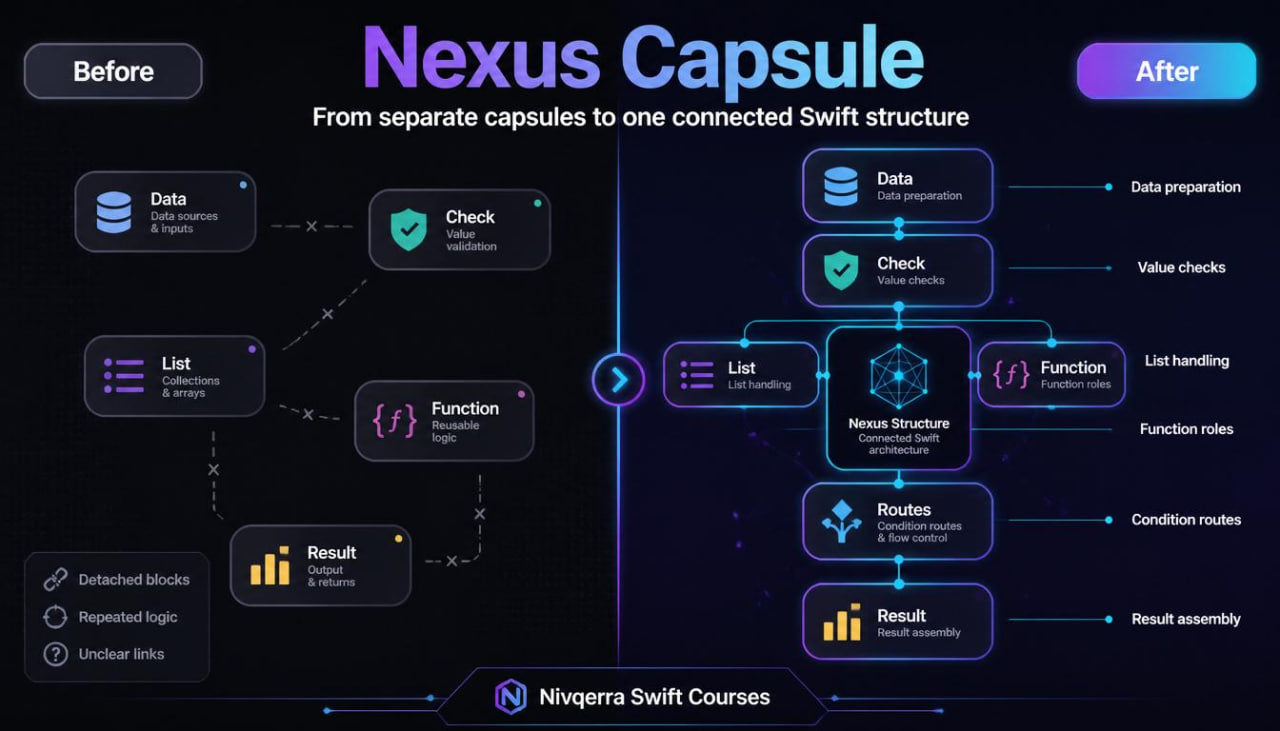
At the ninth stage of study, the learner can already create separate learning fragments, but the challenge appears when several such fragments need to be connected. One capsule may prepare data, another may check it, a third may handle a list, and a fourth may form the final result. Without a readable scheme, these parts may duplicate each other, use unclear names, or pass data in an inconvenient order. The learner may understand each block separately but lose the general logic when there are more blocks. Nexus Capsule was created to teach how to connect several learning capsules into a structured system with clear links.
2. Solution
Nexus Capsule presents Swift through learning links between several code parts. The learner studies how to build not one isolated fragment, but a group of connected blocks, each with its own role. The materials show how data moves between functions, how collections pass through several handling stages, and how conditions affect the general task route. Lessons combine planning, writing code, reading prepared examples, editing, and explaining logic in personal words. This approach helps the learner see not only a separate capsule, but the full learning construction around it.
3. What’s Inside
Nexus Capsule includes a deeper learning route for working with several connected Swift fragments. While Luma Capsule helped build one compact learning capsule, this plan shows how several such capsules can work together within a wider task.
The first module focuses on links between capsules. The learner studies how one part can prepare data for another, how separate functions can support shared logic, and how to avoid mixing different roles in one block. The materials explain why it is useful to separate preparation, checking, handling, and final result formatting.
The second module covers data movement between task parts. The learner follows the path of a value from the starting set to the final block. Examples show how a list passes through checking, then moves into a function, then is handled by condition, and after that is used to create a new set or a short summary. Special attention is given to keeping data clear between stages and making every transition understandable.
The third module is dedicated to role distribution between functions. The learner creates functions for data preparation, value checking, list work, counting, text formatting, and final result assembly. Lessons show how to avoid overly wide functions that take on several unrelated actions. Instead, the learner builds a group of small functions that together form a readable learning system.
The fourth module focuses on collections in multi-step tasks. The learner works with sets of values that pass through several stages: creation, checking, selection, shape change, grouping, and final use. Examples help show how one collection can change through the task or how another data set can be created from it.
The fifth module develops conditional routes. Here, the learner studies how different conditions can send data through different paths. One set of values may move to one function, another to a different function; one check may stop further handling, while another allows the next stage to begin. The materials help keep main conditions separate from helper checks.
The sixth module contains learning systems made of several capsules. Each example is presented in this format: task description, connection map, function set, main code fragment, explanation of the data route, and review task. Topics may include handling a list of study topics, preparing a text summary, grouping values, checking a data set, or creating a short structure for analysis.
The seventh module focuses on editing links. The learner receives a prepared fragment where the parts work, but the structure needs careful review. The task is to find duplication, unclear names, unnecessary transitions between functions, overloaded conditions, or places where data is passed in an inconvenient way. After that, the fragment is revised: functions receive clearer roles, logic is separated, and the connection map is updated.
The plan also includes connection map templates, tables for tracking data movement, checklists for function analysis, a glossary of more advanced ideas, review exercises, and a final learning scenario. In the final scenario, the learner brings several capsules into one system: first describing the idea, then creating a map, writing code, checking data movement, and finishing with a structure review.
4. Who is this for?
Nexus Capsule is suitable for learners who can already create compact Swift fragments and want to connect several such parts into a wider learning structure. This plan is for those who understand functions, collections, conditions, loops, and logic maps, but want to see interaction between several blocks with more clarity.
It is useful for learners who sometimes lose the link between starting data, middle functions, and the final result while working with larger tasks. Nexus Capsule helps view code as a system where every part has its place and data moves through a readable route.
This plan fits well after Luma Capsule, because the learner already knows how to create one learning capsule and now moves into connecting several capsules. Here, it is important not only to write a fragment, but also to explain how it works with other parts of the task.
5. What You’ll Learn
- How to connect several Swift fragments into one learning structure.
- How to define the role of each capsule in a wider task.
- How to follow data movement between functions, conditions, and collections.
- How to create functions with separate, clearly described actions.
- How to avoid repeated logic across several code parts.
- How to work with collections that pass through several handling stages.
- How to create new data sets from starting values.
- How to build conditional routes without extra confusion.
- How to prepare a connection map for a larger learning task.
- How to read execution order between several functions.
- How to edit structure after the first writing pass.
- How to check whether each code part has a readable role.
- How to prepare for the final plan, where the learning system becomes wider and more detailed.
6. 30-day return terms
For paid Nivqerra plans, 30-day return terms apply according to the store rules and refund policy page. Nexus Capsule belongs to these plans, so before placing an order, the learner can review the request process, review period, and terms related to this plan.
On the plan page, this section should be presented without pressure or loud claims. It can state that payment return requests are reviewed within 30 days after purchase according to the store policy. The detailed process is better placed on a separate page, so the buyer can review the rules before placing an order.
Self-paced learning overview
- 📁 Digital file available after purchase
- ♾️ Long-term availability
- 🔒 Secure checkout
- 🗓️ Content updated in 2026
Do I need previous Swift experience?
Do I need previous Swift experience?
No, some courses are suitable for the starting stage, while others are made for learners who already know basic ideas. Each plan presents the level gradually, so the learner can choose materials that match their current stage.
What format do the materials use?
What format do the materials use?
The courses include modules, lessons, explanations, examples, practical tasks, and learning resources. The materials are structured so learners can return to topics and review selected parts during study.
Can I study at my own pace?
Can I study at my own pace?
Yes, the materials can be completed without a strict schedule. You can spend time on topics, examples, and tasks according to your own routine.
Share