Nivqerra
Luma Capsule
Luma Capsule
Couldn't load pickup availability
1. Problem Statement
At the eighth stage of study, the main challenge is often not a separate Swift rule, but the ability to bring several topics into a complete learning fragment. The learner may already understand functions, collections, conditions, loops, and data routes, but when creating a larger example, a question appears: how can all parts work together without turning into a chaotic set of lines? Sometimes a task begins clearly, but too many middle variables, conditions, and helper functions appear along the way. This makes it harder to explain where the main action happens, what should be repeated, and what belongs in a separate block. Luma Capsule was created to help learners build compact, neat, and meaningful Swift learning fragments from several connected parts.
2. Solution
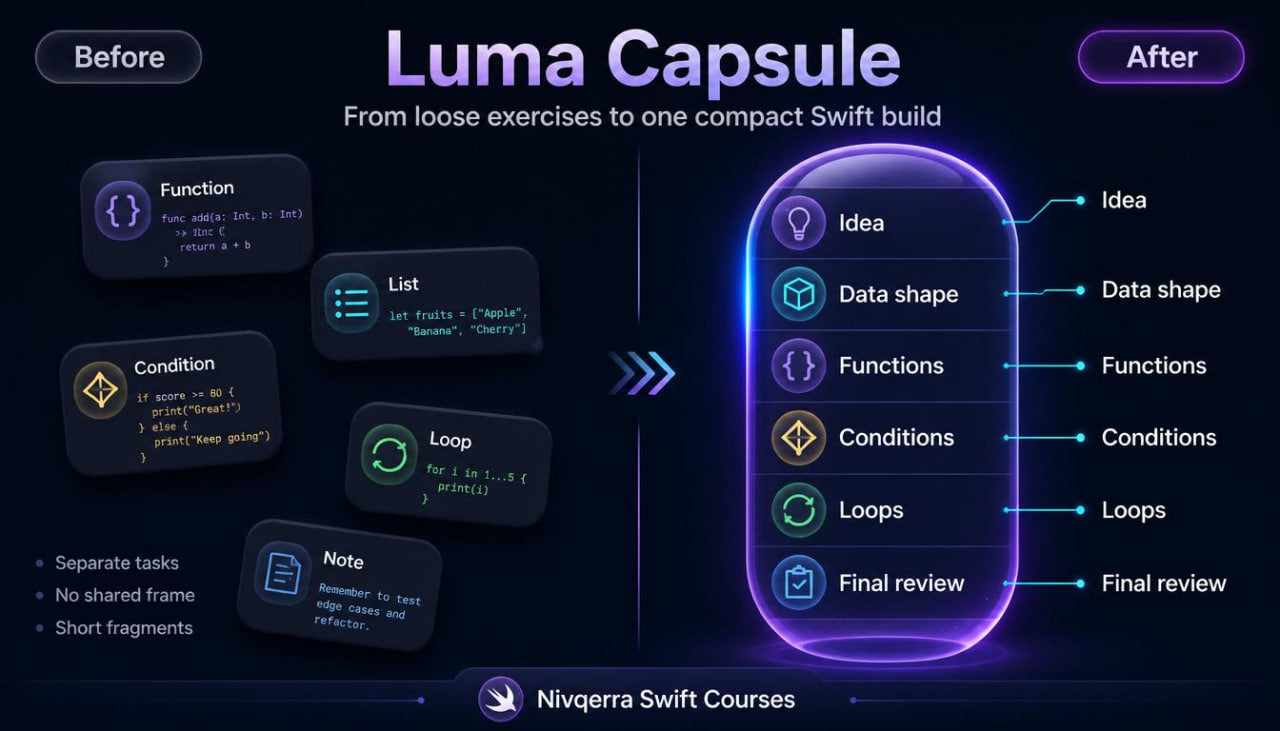
Luma Capsule offers the format of a learning capsule: a small but meaningful fragment with an idea, structure, data, logic, functions, checks, and final review. Each topic is presented as part of a larger build, not as an isolated rule. The learner first studies the task idea, then creates a map of parts, writes the code, and completes the work with a logic review. The materials help the learner work with code carefully: from the first description to the final explanation in personal words. This approach fits the move from separate exercises to compact learning projects where every block has a readable role.
3. What’s Inside
Luma Capsule includes a learning route built around compact project fragments. In this plan, the learner does not only review topics, but brings them into complete learning capsules, each with its own logic, structure, and set of practical steps.
The first module focuses on the learning capsule format. The learner studies which parts form a complete fragment: short idea, starting data, helper functions, main logic, checks, collection work, final result, and summary review. The materials explain why it is useful to view a task not as one long code block, but as a small learning unit with its own inner structure.
The second module covers building the idea. Before writing code, the learner describes what the learning fragment should do. For example: handle a list of values, prepare a short text summary, check a data set, group elements, or create simple decision logic. In this module, it is important to set task borders so the fragment does not become too wide or lose clarity.
The third module focuses on data structure inside the capsule. The learner works with numeric sets, text values, simple records, and lists. The materials show how to choose a data form for a learning example, how to prepare values for handling, and how not to mix starting data with results. A separate part reviews middle values: when they help code reading and when they make the fragment too heavy.
The fourth module develops functions as inner capsule parts. The learner creates functions for separate actions: checking, counting, filtering, text formatting, list handling, and result preparation. Lessons show how to place functions so they are comfortable to read, how to pass parameters, and how to use returned values in the main fragment. An important part of the module is avoiding too many actions inside one function.
The fifth module focuses on conditions and loops in compact projects. The learner studies how conditions affect the logic direction, how loops move through collections, and how these two tools work together. Examples show how to check each list element, select needed values, count totals, and form a new set from starting data.
The sixth module contains a series of learning capsules. Each capsule has a description, logic map, code example, explanation, and task for independent review. Topics may include counting values in a list, handling text elements, creating a short report, checking a data group, building a simple rating without evaluative claims, or forming a learning summary by several rules.
The seventh module focuses on final review and editing. The learner takes a prepared capsule and checks it: whether the idea is clear, whether data and logic are mixed, whether function names fit their role, whether fragments are repeated, and whether the code can be explained without chaotic line-by-line retelling. After that, the fragment is edited: parts move into separate functions, extra lines are removed, names become more precise, and the logic map is updated.
The plan also includes learning capsule planning sheets, tables for tracking data, checklists for structure analysis, a glossary of more advanced ideas, and a set of review exercises. These materials help the learner move from reading large fragments to creating personal compact learning tasks with a clear structure.
4. Who is this for?
Luma Capsule is suitable for learners who have completed the previous plans or have a similar Swift study level. This plan is for those who understand functions, collections, conditions, and loops, but want to combine these topics into complete learning fragments with more clarity.
It is useful for learners who can already read larger code but want to create compact personal examples with clear inner logic. If confusion appeared earlier while working on a larger fragment, especially between data, functions, and conditions, Luma Capsule helps divide the task into manageable parts.
This plan fits well after Vertex Map, because the learner already knows how to see a data route and now moves into creating complete learning capsules. Here, it is important not only to understand a prepared fragment, but also to shape its idea, structure, and final review independently.
5. What You’ll Learn
- How to create a compact Swift learning project from several parts.
- How to describe a task idea before writing code.
- How to set the borders of a learning fragment so it remains readable.
- How to choose a data structure for a specific example.
- How to separate starting values, middle logic, and result.
- How to create functions for checking, counting, filtering, and formatting.
- How to use conditions and loops inside a compact task.
- How to work with lists and form new value sets.
- How to build a logic map for a personal fragment.
- How to explain code behavior in personal words after writing.
- How to edit a fragment and remove repeated parts.
- How to check whether each code part has a readable role.
- How to prepare for the final plans, where learning tasks become wider and more detailed.
6. 30-day return terms
For paid Nivqerra plans, 30-day return terms apply according to the store rules and refund policy page. Luma Capsule belongs to these plans, so before placing an order, the learner can review the request process, review period, and terms related to this plan.
On the plan page, this section should be presented calmly and transparently. It can state that payment return requests are reviewed within 30 days after purchase according to the store policy. The detailed process is better placed on a separate page, so the buyer can review the rules before placing an order.
Self-paced learning overview
- 📁 Digital file available after purchase
- ♾️ Long-term availability
- 🔒 Secure checkout
- 🗓️ Content updated in 2026
Do I need previous Swift experience?
Do I need previous Swift experience?
No, some courses are suitable for the starting stage, while others are made for learners who already know basic ideas. Each plan presents the level gradually, so the learner can choose materials that match their current stage.
What format do the materials use?
What format do the materials use?
The courses include modules, lessons, explanations, examples, practical tasks, and learning resources. The materials are structured so learners can return to topics and review selected parts during study.
Can I study at my own pace?
Can I study at my own pace?
Yes, the materials can be completed without a strict schedule. You can spend time on topics, examples, and tasks according to your own routine.
Share