Nivqerra
Free Kit
Free Kit
Couldn't load pickup availability
1. Problem Statement
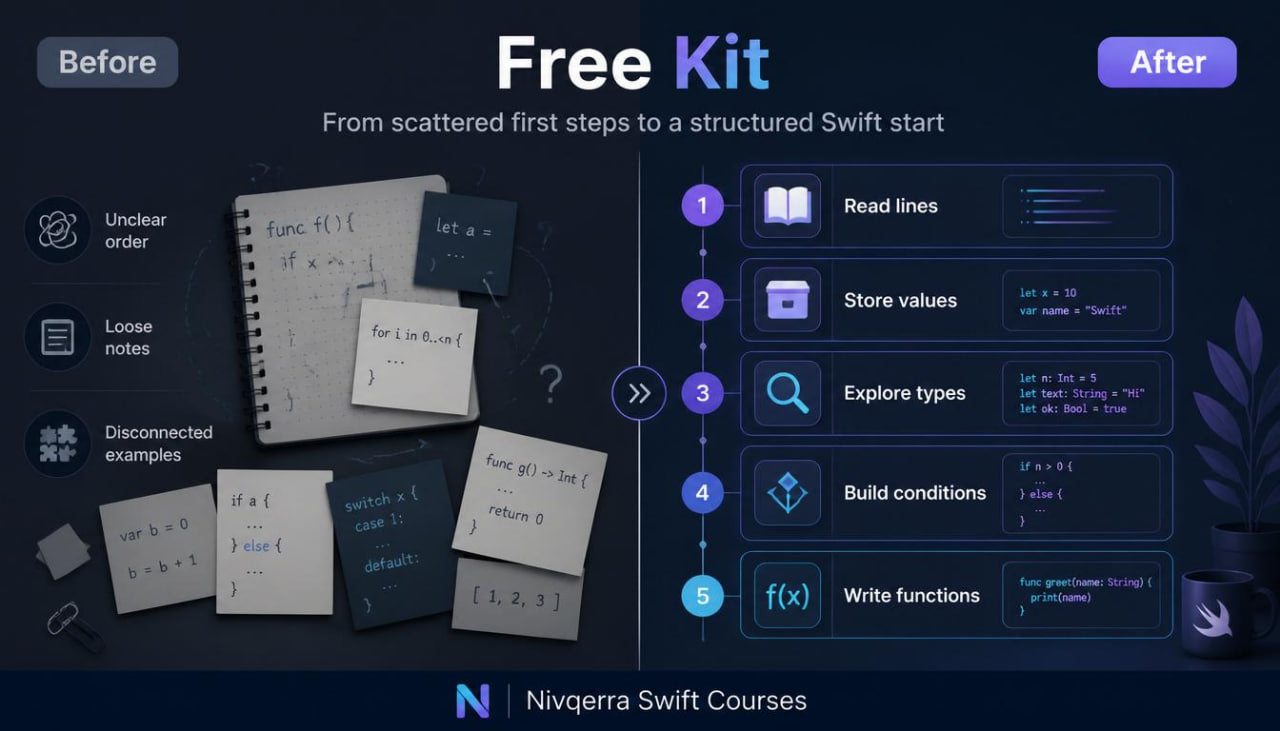
Many learners begin studying Swift through random fragments, short explanations, and disconnected examples, which can make the first steps feel scattered. It is often unclear where to begin: syntax, variables, functions, data types, or code structure. Without a clear sequence, a learner may spend a lot of time searching for materials instead of moving through one topic after another. Another challenge is that early examples are sometimes shown without explaining the logic, so the code may seem to work while its structure remains unclear. Free Kit was created to offer a calm first route into Swift and show how the language can be studied through clear modules, short explanations, and small practical exercises.
2. Solution
Free Kit gives the learner a careful introduction to Swift through a compact but structured set of materials. The plan introduces basic language ideas, shows examples of reading code, and explains how separate parts of syntax connect with one another. Each lesson is built so the learner does not simply copy examples but understands the role of each line. The materials help shape a study habit: first read the explanation, then review the example, then complete a short task. This is not a large course for deep study; it is a starting set that introduces the Nivqerra approach and prepares the learner for the following plans.
3. What’s Inside
Free Kit includes an introductory set of materials that presents the basics of Swift and the Nivqerra learning format. Inside, learners receive a short introduction to the logic of the language: what a code instruction is, how a line of code is read, why data types matter, and how small parts of a program connect.
The first module focuses on learning orientation. The learner receives guidance on how to work with the materials, how to avoid jumping between topics, and how to keep personal notes during study. This module does not overload the learner with terms; it introduces the idea of sequential study: topic, example, explanation, task, and short review.
The second module introduces basic Swift syntax. It covers variables, constant values, simple data types, text values, numbers, and logical values. Each idea is explained through small examples that show how to store information, how to change values, and how to read these fragments without extra confusion.
The third module focuses on conditional structures. The learner sees how code can react to different situations, how checks work, and how to create simple logical branches. The lessons explain not only the written form but also the thought behind the structure: when a condition is met, one fragment runs; when it is not, another fragment runs.
The fourth module introduces functions. Here, the learner becomes familiar with reusing parts of code, parameters, results, and function names. The materials show why functions help make code more organized and readable, even when the examples remain small.
The fifth module includes practical exercises. These are small tasks on variables, conditions, functions, and reading prepared code fragments. The tasks are not designed for pressure or difficult testing; they are included so the learner can reinforce the ideas through personal work with the material.
The plan also includes a short glossary of starting terms. It explains learning words in plain language: variable, type, condition, function, parameter, value, and result. This glossary helps learners return to ideas while moving through the lessons.
A separate part of Free Kit is a mini study plan. It suggests how to divide the topics into several study sessions, how to review examples, and when to move to the next Nivqerra plan. The plan does not impose a strict schedule; it gives a reference point for calm study.
4. Who is this for?
Free Kit is suitable for learners who are just looking into Swift and want to understand the Nivqerra learning approach. It is a good starting point for people who have seen code before but do not yet have a clear system in mind. The plan is also useful for those who have tried studying Swift but felt that the materials were too scattered or did not explain the basic logic.
Free Kit can be chosen by learners who want to get familiar with the language without a large volume of materials at the start. It is also suitable for reviewing basic ideas before moving to wider courses. For learners who want to check the explanation style, task type, and general structure of Nivqerra, this plan gives enough material for the first introduction.
5. What You’ll Learn
- How to read simple Swift code fragments without chaotic searching for every symbol.
- How variables and constant values work in starting examples.
- How to distinguish text, numeric, and logical values.
- How simple conditions and logical checks are built.
- How to create small functions and understand their role in code.
- How parameters and function results work.
- How to keep notes during study and return to important ideas.
- How to review an example not only by form but also by logic.
- How to complete small practical tasks after a topic explanation.
- How to prepare for the next Nivqerra plans through basic Swift ideas.
6. 30-day refund terms
For paid Nivqerra plans, a 30-day refund window applies according to the store rules and the refund policy page. Since Free Kit is provided at no cost, refunds do not apply to it. When a learner moves from Free Kit to a paid plan, they can review the refund terms before placing an order.
We present this section transparently, without exaggerated claims or pressure on the buyer. The learner can review the Free Kit format, evaluate the material style, and decide whether further study with Nivqerra fits their needs. All terms should be described on the relevant store page in clear language, so the buyer can see the request process, review period, and refund format for paid plans.
Self-paced learning overview
- 📁 Digital file available after purchase
- ♾️ Long-term availability
- 🔒 Secure checkout
- 🗓️ Content updated in 2026
Do I need previous Swift experience?
Do I need previous Swift experience?
No, some courses are suitable for the starting stage, while others are made for learners who already know basic ideas. Each plan presents the level gradually, so the learner can choose materials that match their current stage.
What format do the materials use?
What format do the materials use?
The courses include modules, lessons, explanations, examples, practical tasks, and learning resources. The materials are structured so learners can return to topics and review selected parts during study.
Can I study at my own pace?
Can I study at my own pace?
Yes, the materials can be completed without a strict schedule. You can spend time on topics, examples, and tasks according to your own routine.
Share