Nivqerra
Axis Set
Axis Set
Couldn't load pickup availability
1. Problem Statement
After the first introduction to Swift, many learners meet a new challenge: separate ideas may already feel familiar, but they do not yet form a complete picture. Variables, conditions, functions, and data types can make sense on their own, yet confusion may appear when writing personal examples. A learner may know what a certain structure looks like, but not always understand when to use it. There is often a lack of small exercises that gradually combine several topics in one task. Because of this, study can become a group of fragments instead of a steady movement from basic ideas toward reading and writing code independently.
2. Solution
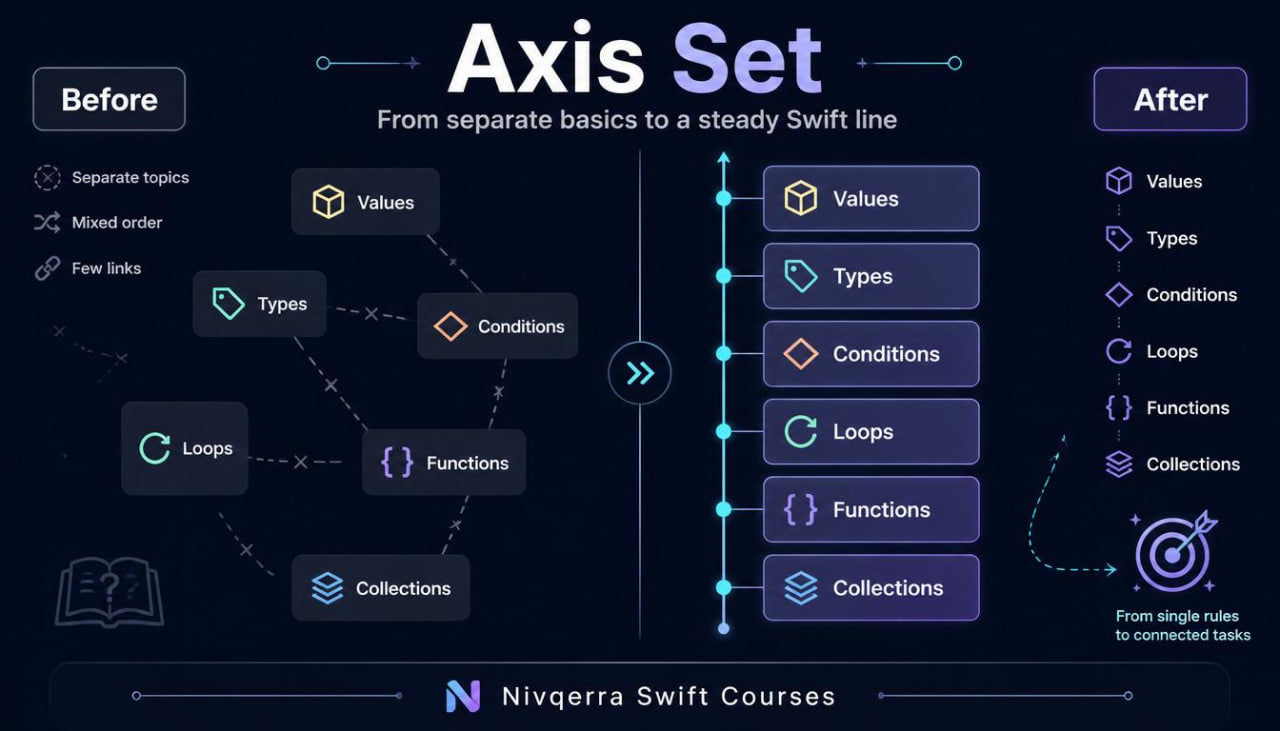
Axis Set helps organize starting knowledge and bring it into a clear learning line. The materials explain not only separate Swift rules but also the connections between them: how values move into variables, how conditions guide logic, and how functions separate parts of a task. Lessons are presented through short theory blocks, examples, and exercises where the learner gradually moves from reading code to creating small personal solutions. The plan is built so each new topic rests on the previous one and does not feel detached from the general structure. This is a useful stage for those who want to continue after the introductory set and study the basic mechanics of Swift more carefully.
3. What’s Inside
Axis Set includes an expanded starting route that deepens the topics from Free Kit and adds new learning blocks. At the center of this plan are Swift code structure, working with data, logical checks, functions, and small exercises that combine several ideas.
The first module is dedicated to reviewing starting ideas. The learner returns to variables, constant values, data types, and basic operators, but not only as a short introduction. The materials show how these elements interact in small examples: how a value is stored, how it changes, how it moves further, and how it affects the next lines of code.
The second module studies data types more carefully. Here, the learner works with text values, numbers, logical values, and basic conversions. The materials explain why the language needs to understand the type of a value, why not all data can be combined without preparation, and how to read type-related error messages.
The third module focuses on conditional structures. It covers checks, comparisons, nested conditions, and several directions of code logic. The learner sees how one code fragment can behave differently depending on input values. Special attention is given to reading conditions: how not to get lost in brackets, operators, and nested blocks.
The fourth module introduces loops. The materials explain how repeated actions can be written in a shorter and cleaner way. The learner becomes familiar with basic examples of repetition, counting, going through values, and performing the same action for several elements. Loops are presented through practical situations: processing a list of numbers, checking several values, and creating a repeated result.
The fifth module expands the topic of functions beyond Free Kit. The learner studies parameters, returned values, function names, and splitting a task into smaller parts. The lessons show how a function can receive data, process it, and return a result for later use. The module also explains why names should be clear and why functions should be written in a way that remains readable later.
The sixth module introduces basic collections. The learner works with lists of values, learns how to add elements, refer to them, check their count, and use collections together with loops. The topic is presented through small examples: a list of scores, a set of names, a sequence of numbers, and a table of simple values.
The seventh module contains a practical task set. Here, the learner combines variables, conditions, loops, functions, and collections in small exercises. For example, they create a value check, form a short report from a list, write a function for data handling, or read a prepared fragment and explain what happens inside it.
The plan also includes a learning glossary with short explanations of terms used in the modules. It helps learners avoid stopping every time a term appears and makes it easier to return to explanations during review. In addition, the learner receives a study plan for the tariff: how to divide modules, when to work on exercises, how to review topics, and how to move to the next plan without a sharp jump in difficulty.
4. Who is this for?
Axis Set is suitable for learners who have already seen basic Swift examples and want to organize their knowledge into a clearer system. It is a good choice after Free Kit when the starting ideas no longer feel completely new, but more practice and stronger connections between topics are still needed.
The plan also fits learners who have tried studying from different sources and felt that the topics became mixed together. Here, the materials follow a calm sequence: from values and types to conditions, loops, functions, and collections. A learner can use Axis Set as the first wider learning stage or as a review of basic topics before moving to more advanced plans.
This plan is useful for those who want not only to read code but also to begin writing small fragments independently. It does not overload the learner with large projects, but offers many short exercises that help show the connection between topics. Axis Set also fits learners who value structured materials, a study plan, and examples they can return to during review.
5. What You’ll Learn
- How to combine variables, constant values, and data types in small examples.
- How to read code in sequence, line by line, without losing the general logic.
- How text, numeric, and logical values work in Swift.
- How to perform basic value conversions and understand type-related errors.
- How to build conditions with several directions of logic.
- How to use nested conditions without confusion in structure.
- How to use loops for repeated actions.
- How to work with lists of values and combine them with loops.
- How to create functions with parameters and returned values.
- How to divide a small task into clear parts.
- How to write variable and function names so the code remains readable.
- How to complete practical tasks that combine several topics.
- How to use the learning glossary during review.
- How to prepare for the next plan through organized review of basic topics.
6. 30-day refund terms
For paid Nivqerra plans, a 30-day refund period applies according to the store rules and refund policy page. Axis Set is a paid plan, so the learner can review the terms before placing an order. The policy page should clearly describe how to submit a request, what details to include, and how the request is reviewed.
This section should be written in a calm tone, without pressure and without exaggerated claims. The buyer should see a clear order of steps: where to find the refund policy, how to contact the Nivqerra team, and how the request review works. The wording should remain neutral and match the general store style, so the plan page feels transparent and appropriate.
Self-paced learning overview
- 📁 Digital file available after purchase
- ♾️ Long-term availability
- 🔒 Secure checkout
- 🗓️ Content updated in 2026
Do I need previous Swift experience?
Do I need previous Swift experience?
No, some courses are suitable for the starting stage, while others are made for learners who already know basic ideas. Each plan presents the level gradually, so the learner can choose materials that match their current stage.
What format do the materials use?
What format do the materials use?
The courses include modules, lessons, explanations, examples, practical tasks, and learning resources. The materials are structured so learners can return to topics and review selected parts during study.
Can I study at my own pace?
Can I study at my own pace?
Yes, the materials can be completed without a strict schedule. You can spend time on topics, examples, and tasks according to your own routine.
Share